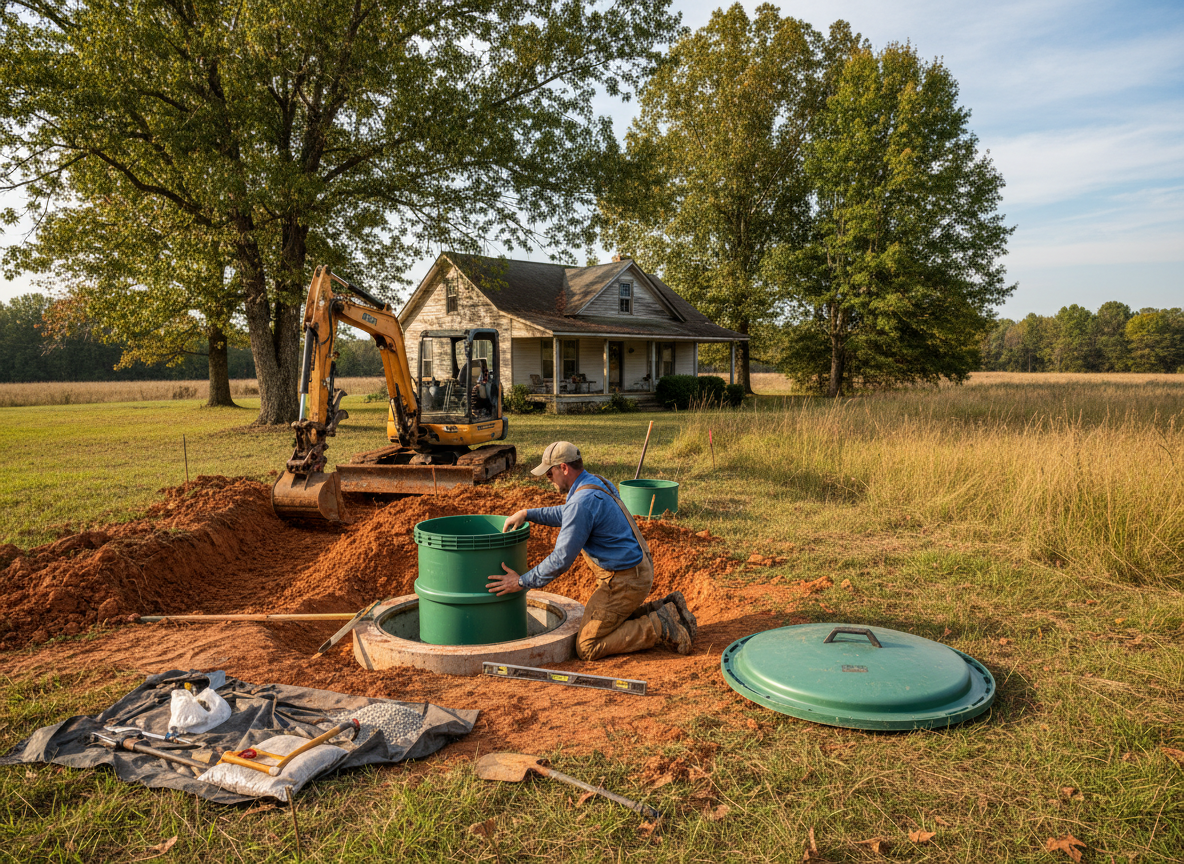
On rural lots off sewer around Carrollton, many original tanks sit buried under several feet of red clay that compacts and holds water after heavy spring rains. We locate the tank by following the inlet line from the house, then probe for the lid while checking for tree roots that commonly grow toward the tank in the Piedmont terrain. Once uncovered, we note the condition of existing baffles and inlet or outlet tees before deciding whether a riser will clear the seasonal water table.
We check saturation around the drain field and distribution box during wet periods because clay soil drains slowly and can push effluent back toward the tank. Risers are measured to sit just above grade so future pumping visits avoid digging through the same heavy soil. On lots near the Little Tallapoosa River or along GA-166, we also verify that the riser will not interfere with surface drainage during summer storms.
Homeowners in older subdivisions near Adamson Square and the University of West Georgia often discover their tanks lack any access point when backups or sewage odor appear. Adding risers lets us reach the sludge and scum layers quickly without repeated excavation. The work accounts for the humid subtropical climate that keeps soil moist most of the year, so we compact the backfill carefully to prevent future settling around the new lids.
Technician insight
In Carrollton the thing that catches most people out with Septic Riser Installation is how fast red clay settles after heavy spring rain around older tanks near the Little Tallapoosa River. Homeowners often think a shallow riser will work until the next wet season pushes the lid back below grade.
Riser Added on Lot Off GA-61
Problem: sewage odor and slow drains after spring rains on a rural Carroll County lot. What we found: original tank buried three feet deep with no access, red clay holding water around the drain field. What we did: installed two risers over the main compartment and effluent filter. Outcome: tank now reachable for regular pumping without repeated digging.
Septic Riser Installation Services We Offer
✓Riser Extension Installation
Extends existing access points so the lid sits above grade on deep tanks common in Carroll County red clay.
✓Septic Lid and Riser Replacement
Replaces cracked or missing lids with durable covers that keep water and roots out of the tank.
✓Effluent Filter Riser Access
Adds a riser directly over the effluent filter so it can be cleaned during regular septic pumping visits.
✓Pump Chamber Riser Addition
Installs a riser on the pump chamber so float switches and alarms remain reachable without excavation.
✓Distribution Box Riser Upgrade
Provides surface access to the distribution box for checking flow across the drain field after heavy rains.
How it works
- 1
Locate and Expose Tank
We trace the sewer line from the house and probe through the red clay to find the buried tank and existing lid.
- 2
Assess Internal Components
The tank is opened to inspect baffles, inlet and outlet tees, and sludge levels before any riser work begins.
- 3
Install and Seal Riser
A properly sized riser is attached to the tank lid opening and sealed to prevent groundwater intrusion in the clay soil.
- 4
Backfill and Grade Surface
Soil is compacted around the riser and the area is graded so water flows away during Carroll County spring rains.
Pricing
Cost depends on tank size, access difficulty, and existing condition of the lid and baffles.